Becoming through artistic practices of co-existence with atrocities
– a complex process of revelatory, primordial phenomena.
A week's reflection on a performance may be enough time to look at videos and revisit what had actually happened at The Commons, at the performance of Requiem-to-Come. But I need far more than a life-time to investigate the performativity that transpired in the air around people’s lives – audience members – and my own discourse. Even though I am keenly drawn to reflection, I am not an ideal forensic practitioner. Therefore, I consider myself fortunate to have received deeply thoughtful reflections on audience members’ experience at the performance.
A week's reflection on a performance may be enough time to look at videos and revisit what had actually happened at The Commons, at the performance of Requiem-to-Come. But I need far more than a life-time to investigate the performativity that transpired in the air around people's lives – audience members – and my own discourse. Even though I am keenly drawn to reflection, I am not an ideal forensic practitioner. Therefore, I consider myself fortunate to have received deeply thoughtful reflections on audience members' experience at the performance, and I will paste some of these reflections below.
But first, the question of "what am I becoming?" as a result of this performance. When I look at an almost daily conducting of this kind of performative work at home, I am in appreciation of a practice that serves a number of functions. It is fair to say that dancing-the-piano in response to the world with sound/voice/glossolalia as a most direct manifestation of my meeting the world halfway, situated publicly as a genre of theatre, "pulls me through" one state to become an indeterminate other. This is not something one can easily write about, or discuss, or have an articulated opinion about. It was a highly intimate (personal) response to matters I have brought into the room, one of sensitising somatics and a sphere of feelings. I will highlight one such a facet of the performance here.
As I explained in my narrative, that since childhood I have always been "open" to the world, the news, information on what is happening around me (give or take current variations of "truth") and my direct confrontation of these. And I have come away with a sense that I am "still" (?) psychologically "balanced" (?) "congruent" (?) and thoughtful in a discursive manner. Except for one incident 32 years ago namely when I watched a film on female genital mutilation, FGM, in Africa while I was pregnant. This event did not move "through me", but is still present "as me", a grotesk realism, an astonishment spliced in with a profound question: But why?. Why do young girlchildren have to be mutilated to serve patriarchal systems of oppression, marriage rerquirements, social acceptance, religion, while I know, and can fully understand patriarchal domination with a bewildered and archaic sexism as one of a deeply disturbed face of humanity on my continent. This is where understanding does not solve the problem. And this was where, once again, I had to dance-and-voice-the-piano with this image in my bodymind ... that would not leave me.
The body comes before words. In Requiem-to-Come it is accompanied by heteroglossia – different /many tongues / other languages. I allowed my praxis to become performative of the relational immanence – where life and thought happen on one single level, without hierarchy – of FGM. The conduit of my performative mind-bodiment was a temporary reversal of social hierarchies and norms, that which brings with it the degradation of everything spiritual and noble about being a girlchild in Africa. The performance was a moment of liberation and suspension of official discourse allowing alternative voices and perspectives to emerge – a twist by subversion. A momentary subversion of a flat ontology of hierarchy, a momentary upturn of hierarchical politics, yet it was/is/will be no small matter.
This genre of performance refutes representation. It is a fluid theatrical form that cannot repeat itself. When you repeat a revelation, the fibre of the its resolve, frays. FGM in this context, is a case in point. FGM as I internalised it has a certain frequency of barbarism – a personal, collective and ecological trauma – while the politics remains unresolved – yet performatively mind-bodied by an elder woman of my standing, with consequences, one through change which is biological, bypassing the rational brain. Yet it's aesthetic context makes it art, albeit with a profound ethical provocation in the room of the performance. It was an artistic rendition of a visceral confrontation of complicity in all present. While this event was a ritual in the form of a requiem for FGM practiced and still-to-come, it will not again be done. A ritual transforms, and the new configuration is (such as the throwing of bones as divination) like the writing on the wall: done. The performativity allows for a deliberate attunement to possibilities, new modes of thinking and being-with the world. The ethics of the performance are the ethics of care, resistance, de-post-colonisation, reconnection, regeneration ... The existence of FGM enhances, influences, radicalises and politicises our future practices. To think-in-movement and the long-song-breaths of this form, transforms everything. Potentially, this makes every being a voicing philosopher immersed in an activism in a world engulfed in catastrophe.
Bodymindedly, it is crucial to perform atrocities – complexly, primordially, divinationally – as the body exists in relation to all life – integrally sustained, accountable, in solidarity with everything, with performative gestures of togetherness – panaesthetically. This is one possibility of what is human about being and becoming human, a mind-bodied actuality.
Sentiment without action is the ruin of the soul.
As indicated, here is some thoughtful labour from some who have attended.
Van Tonder models this to the audience as a self-created daily practice, as healing modality and as aesthetic immersion.
Her artistic signature is embedded in a life-long pursuit of these forms as an independent, practicing, critical psychologist and a dance performance artist spanning her bodymind into other modalities. Some themes would be recognised as transgressive, feminist, immersive and as psychological formations of archaic structures not necessarily available to humans in worded language.
The artistic product offers a radical way of being, a particular embeddedness in deeply human expressions with rich manifestations of life with an "unflinching gaze" (Arundathi Roy)."
Richard Pakleppa (Film maker)
She tells a delightful personal South African story, with ease and much humour, knitting together her love of dance and the piano. She inhabits both, including the release of a voice, sung/spoken/sounded that seems to know no bounds of pitch or resonance. Full throttle comes to mind but simultaneously, finely tuned and delicate. The experience is a richly textured one. Rich skills and years of intellectual mapping underpins the magic.
If you want to know the details of the material, you should read the artist's own words in her extraordinary website: https://theimageofyourperfection.co.za/archive/index2.php
Here you will be invited to absorb decades of the profound life force of this independent artist.
For me the end of this event, where she invites the audience into a simple gesture, is the greatest gift of this work. I was in my best self, my reaching self, full of hope and fully present and most importantly, unflinchingly connected to everyone in the room and beyond."
Jennifer Steyn (South African actor)
Always already, we participate in lament as a loving-to-come..."
Nan Hamilton (Body-worker)
The piece begins with beautifully articulated story-telling, as Nobonke reflects on aspects of her childhood, in particular the ritual of listening to the News (die nuus). This was a time when the news did not tear at the fabric of your being, when it was safely wrapped in a leather bound radio, when listening to it was a solemn daily ritual that did not shake your foundations. When you could meet it halfway. But one day, when she was an adult, something flipped. Whether it was the particular brutality of the news item, or because she was older and more aware, it ripped through her. And she could no longer meet the news at all...
Although much is wordless, the piece eloquently expresses the horror, disbelief, and cognitive dissonance that any thinking and compassionate person must feel today. In this time of apocalypse, the news cannot be met, because it is a sprawling monster of cruelty, pain, selfishness, greed. We are all in need of a requiem, to help us mourn what has come and what is still to come.
Nobonke's requiem is expressed through piano music, through body movement and gesture, through painting, and through one of the most powerful displays of the voice as an instrument that I have ever heard. While hard hitting, it offers hope for a different way of being, and is also cathartic, giving voice to much of the anguish we carry inside us every day in this time of genocide, climate collapse, and the growing threat of fascism.
It reminds us all to keep feeling, however much it hurts, because caring and compassion are the strongest tools we have in an era when empathy is seen as weak or dangerous, when the ruling powers are resolved to turn all into unfeeling automatoms. Requiem-to-Come is a masterful and timely performance, and should not be missed.
Briget Pitt (South African writer).
This turns out to be a big and urgent question, but in Tossie van Tonder's recent performance/conversation/interrogation, Requiem-to-Come, it started through a personal story: a five-year-old girl's fascination with a piano, her father's insight that this was what she needed, and her mother's assumption that this girl's constant dancing round the house and garden could properly be channeled through ballet classes.
‘Playing the notes' and ‘doing the steps' proceeded successfully enough through her teenage years, but the orderedness and certainty of these systems seemed increasingly at odds with the world that the young woman was experiencing, and her practice in sound and movement took on its own direction, turning to freer expressive purposes the tools of discipline and expression that the world had provided.
However, this relatively free-flowing state of being was shockingly fractured by her confrontation with the painful and traumatic practice of female genital mutilation, carried out by older women on behalf of a complacent patriarchy. How is one to cope with (to meet half-way) such atrocities? Having seen that (so close to home for a young woman), what else do you see?
Van Tonder turns to the piano, whose panels have been removed to display its working parts, and ‘plays the notes' of her own spontaneous expression of sorrow and outrage. Pausing, she notes that the wood, metal and plastic manufactured elements of the piano evoke images of extractive violence and, by extension, potential human catastrophe, with nuclear war on the horizon.
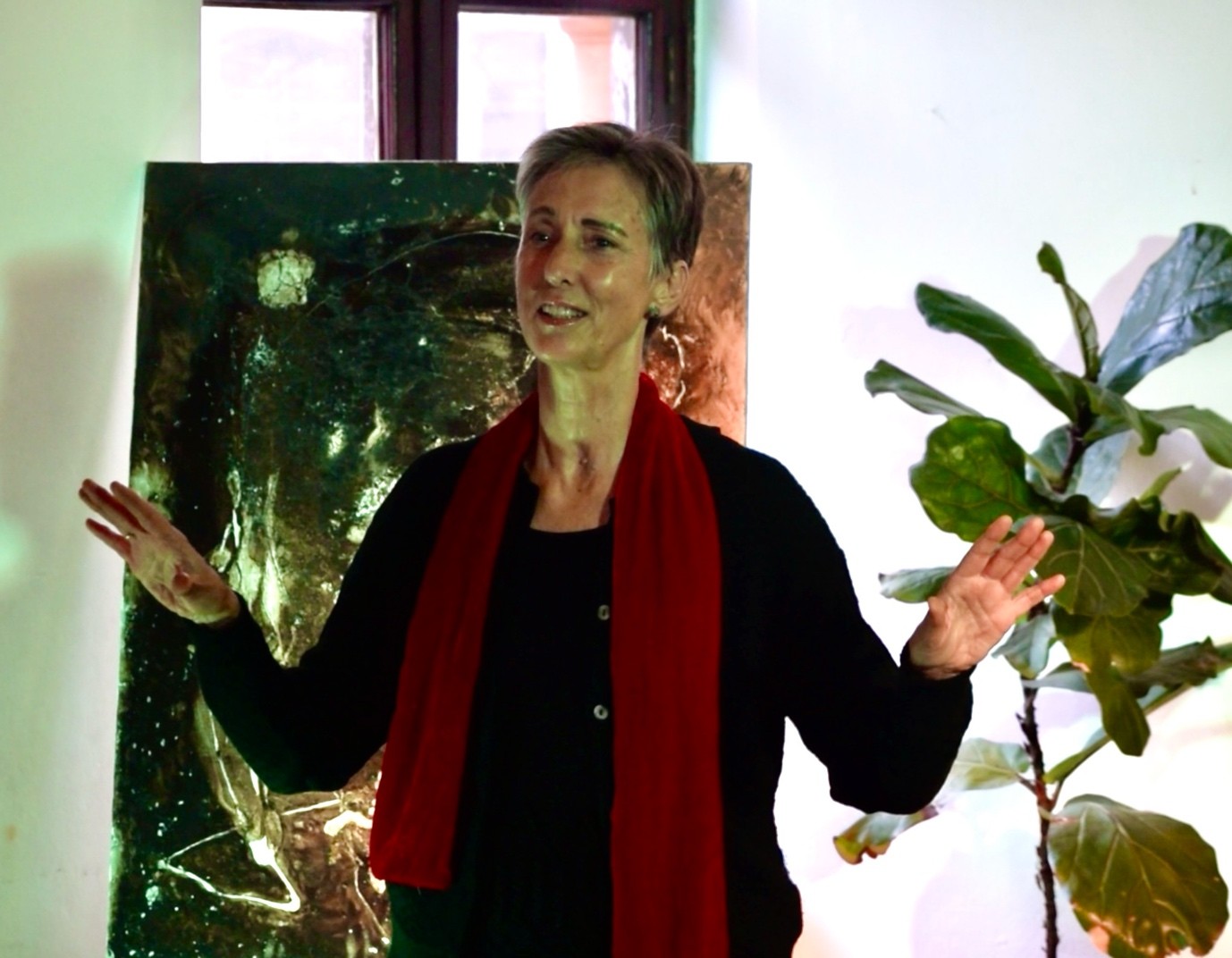
She turns to a large predominantly black painting on an easel: its basic layer Is made of biochar, partly burnt and charred wood with a slightly sticky texture. The manipulated surface and added glimpses of colour produce enigmatic images, with no ‘right way up', no certainty of interpretation. Wood, ordered or smeared, is the primary material of both piano and painting, each representing in its material form a hint at a view of the world.
The image of a child and a piano have led, through story, unpredictable and evocative sound and references to the fragile materiality of familiar objects, to a sense of pre-emptive mourning for the unreliability of familiar forms of order. Van Tonder suggests that elderhood provides the opportunity, limited though it may be, to reflect and act with integrity in this time of radical uncertainty, and with striking but unspoken irony, she carefully restores the piano to its skillfully ordered state, replacing three panels of wood over hammers, cast iron, copper and plastic.
The painting revealed as "smeared" with biochar, an agricultural product she manufactures herself intimated that on this planet we will confront the heat of excess. But have we inoculated it with our best substance for it to outlast human existence?
John Cartwright (Retired professor in English)